http://www.lua.org/portugues.html
The Economy
The difference in the percentage of people using game engines versus those who want to is certainly interesting. Could the high level of use have something to do with the economy, or with the increasing cost of development? I asked the producers whether they’ve found themselves with tighter budget constraints due to the economy. 78.6% responded yes. But in the comments many people pointed to tighter control over their budgets, as opposed to diminishing budgets.
Following up, what has been the impact of these rising development costs and a dwindling economy? What concerns have increased most for developers in recent years? The five most popular responses were:

Increasing development cycle length, increasing headcount, trying to create game designs that stand out from the pack… these are fairly consistent game developer challenges. But looking for rapid prototyping and rapid iteration tools? Here we find interesting new news. Rapid prototyping enables a developer to more quickly draft and test game concepts for fun in the early stages of a project, and also use the prototype to acquire funding. Rapid iteration gives one the ability to quickly try out many ideas during development, improving the game through frequent experimentation and fine-tuning.
If rapid prototyping and rapid iteration are weighing heavily on people’s minds, what are they using now? And how many studios have live preview on the target platform in their current content pipelines?
I asked, “what are you using for rapid prototyping?”

Several people noted that are using their previous engine versions to create prototypes for the next game. But what do new studios use? It looks like they probably create one-off C++ applications, sketch things out on paper, or use Flash or Lua. I had suspected that more developers would be using C#/XNA due to the ease of quickly knocking out quick test applications with it, but only 5% of the responders said they are using this for prototype development. (However, 76% of developers are using C#/XNA for tool building.)
If rapid iteration is also a growing concern in game development, how many developers currently have the ability to do live preview on the target platform for their content developers (artists and designers)? According to the results, 62.5% currently have this capability. Several responders noted that they preview on a PC version of their engine and that this is good enough for most work. Certainly using the actual target platform would be even more valuable though!
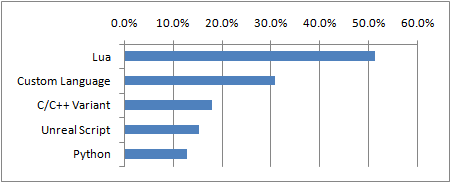
One useful tool for rapid iteration during development is the use of interpreted scripts; if the designer can write in a script language and immediately execute it on the target platform (as opposed to a long recompile or download), the iteration cycle can become quite fast, enabling many experiments and much more fine-tuning of gameplay ideas. But what script languages are most people using? (This query supported multiple replies.)
....
http://www.satori.org/2009/03/the-engine-survey-general-results/


